
terça-feira, 5 de agosto de 2025


terça-feira, 3 de junho de 2025

quinta-feira, 22 de maio de 2025

segunda-feira, 12 de maio de 2025

segunda-feira, 28 de abril de 2025

sábado, 14 de setembro de 2024

segunda-feira, 8 de julho de 2024
Why everyone should think like a lawyer - The economist Jun 27th 2024
The unloved profession has a lot to teach managers
Jun 27th 2024
LAWYERS ARE often seen as the most tedious of professionals. And the most derided ("What do you know when you find a lawyer up to his neck in concrete? Someone ran out of concrete"). Yet that damning reputation is undeserved: lawyers are in fact role models. The method and meticulousness entrenched in the legal style of thought has something to teach other knowledge workers and their managers.
In "One L", a book about his first year at Harvard Law School, Scott Turow describes the slow, arduous progress of going over his first case as "stirring concrete with his eyelashes". But legal education is not about specific cases or statutes. It is, as Mr Turow later understands, about processing a mountain of information and exercising judgment. It teaches how to infer rules from patterns, use analogies, anticipate what might happen next, accept ambiguity and be ready to question everything.
The sober way of going about this is by sticking to the facts. What matters is what you can prove. In her final year of law school, this guest Bartleby gave her hairdresser of many years advice on whether another client's behaviour amounted to breach of contract. It did not—the law did not offer an effective remedy for that problem. This left the salon owner grateful not to be spending resources on a lost cause. (She proceeded to remunerate your columnist with a free haircut.)
In a world of business that is increasingly dominated by amorphous, ever-changing markets, the interaction might sound familiar to managers, and many of their subordinates. White-collar workers, after all, also need to remain rational in the face of unexpected situations and undeterred by initial incomprehension. No lawyer knows every law, but by the time their training is over they are calm in the face of the unknown and know how and where to look anything up. Likewise, anyone running a company will never have all the answers. What they need is equanimity and a method of quickly arriving at conclusions that are likelier than not to be the correct ones.
Managers also have something to learn from the adversarial legal system, central to common-law jurisdictions like America's and Britain's, where advocates represent their parties before an impartial arbiter (usually a judge and a jury). In preparing for trial, lawyers attempt to identify and rehearse both sides of litigation. By putting themselves in their opponents' shoes they are forced to engage with a line of reasoning with which they may disagree.
In so far as managing employees is, like arguing a case before a court, about persuasion, managers would be wise to adopt some of the same tactics. That means avoiding emotional reactions (lawyers may try to appeal to jurors' feelings but they never let their own get in the way). It also means considering the strongest criticism of their own reasoning. This not only makes their own arguments bulletproof but is liable to look fair in the eyes of employees and fellow managers. (Plus, a friendly but thorough performance review is essentially a mock cross-examination of your witnesses.)
Law, after all, is a way of dealing with social stress. If attorneys are trained for one thing, it is on how to maintain focus, precision and a clear strategic plan in the midst of a crisis. When a team feels a wrong should be redressed, a manager should look for the rule that governs the conduct in question, how that rule was applied in the past and act in a way that seems morally defensible. If the crisis is external, a manager should also follow precedent, which is the basis of common law and much of what lawyers do in court. The purposefulness and heady resolve that characterise most lawyers are attributes that executives, too, should cultivate. There is no room for passivity when something goes wrong, only for action.
Perhaps the most valuable lesson from lawyers is both the most obvious and the most scorned. The antidote to work anxiety is not taking your mind off work with meditation or Netflix. It is disciplined preparation. There are rewards in leaving no stone unturned. By putting in the hours, even if these are not billable, managers can ensure they are as ready as they can be for the uncertainties that lie ahead. As an added bonus, hard graft wins them the respect of colleagues and subordinates.
Your columnist ended up not pursuing a career in law. But she never regretted her training as a lawyer—and not just because of the free haircut. ■
 | Sent with Mailsuite · Unsubscribe | 08/07/24, 15:12:38 |

segunda-feira, 18 de dezembro de 2023

quarta-feira, 27 de setembro de 2023

quarta-feira, 16 de agosto de 2023

segunda-feira, 6 de fevereiro de 2023
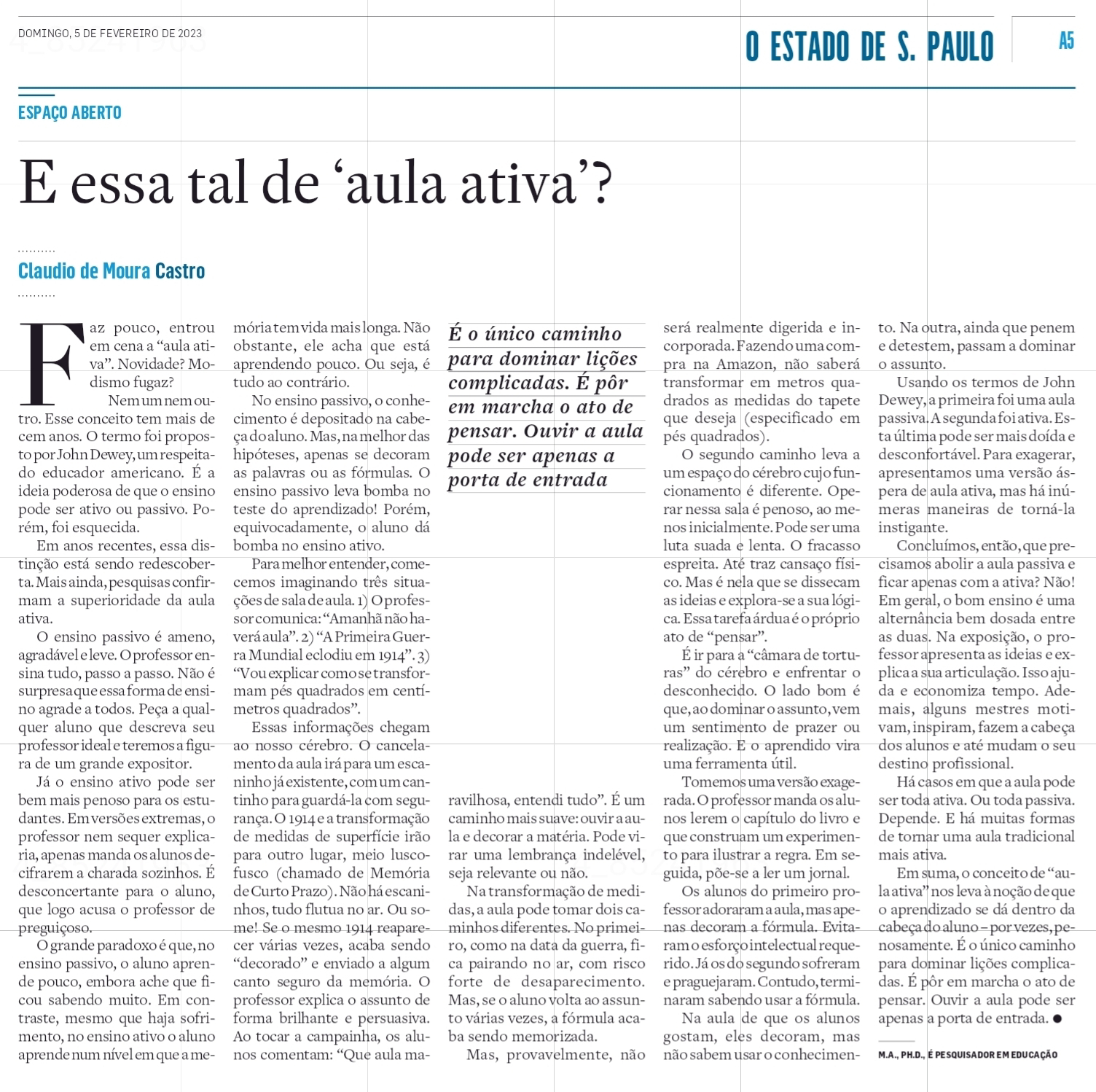

quarta-feira, 9 de setembro de 2020

terça-feira, 24 de dezembro de 2019
Lawmakers deliberate China’s draft civil code
Lawmakers deliberate China's draft civil code
Shanghai Daily
24 dez 2019
CHINESE lawmakers yesterday started deliberating a draft civil code as part of the priorities of a session rounding out the country's legislative work in 2019. The draft civil code, consisting of general provisions and six sections on property,...
leia mais...
Este e-mail foi-lhe enviado por um utilizador do PressReader.com, serviço do PressReader, Inc. – uma fonte de publicações online de todo o mundo. O PressReader.com Service contém material sujeito a copyright, marcas registadas e outra informação proprietária. A recepção deste e-mail não deve ser interpretada como concessão de quaisquer autorizações, expressas ou implícitas, à propriedade intelectual do PressReader, Inc. , PressReader.com ou aos editores das publicações apresentadas.
PressReader.com – Redefinindo a Experiência de Leitura.
PressReader.com é um serviço do PressReader, Inc.
PressReader, Inc., 200-13111 Vanier Place, Richmond BC V6V 2J1, Canada
Telefone: +1 (604) 278-4604
©2003-2018 PressReader, Inc. Todos os direitos reservados.
sexta-feira, 18 de outubro de 2019

sexta-feira, 26 de julho de 2019
More technology will lead to fewer lawyers
More technology will lead to fewer lawyers
MITCHELL KOWALSKI
The Australian
26 jul 2019
A few years ago, someone asked me, "What's the future of legal services?" I answered, "More technology and fewer lawyers." At the time I was being cheeky, but now, in a world where our personal and work lives are increasingly focused on mobile...
leia mais...
Este e-mail foi-lhe enviado por um utilizador do PressReader.com, serviço do PressReader, Inc. – uma fonte de publicações online de todo o mundo. O PressReader.com Service contém material sujeito a copyright, marcas registadas e outra informação proprietária. A recepção deste e-mail não deve ser interpretada como concessão de quaisquer autorizações, expressas ou implícitas, à propriedade intelectual do PressReader, Inc. , PressReader.com ou aos editores das publicações apresentadas.
PressReader.com – Redefinindo a Experiência de Leitura.
PressReader.com é um serviço do PressReader, Inc.
PressReader, Inc., 200-13111 Vanier Place, Richmond BC V6V 2J1, Canada
Telefone: +1 (604) 278-4604
©2003-2018 PressReader, Inc. Todos os direitos reservados.
sábado, 18 de maio de 2019
LAW MUST DEAL WITH DIGITAL ERA … OR ELSE - Vancouver Sun de 17.5.2019
LAW MUST DEAL WITH DIGITAL ERA … OR ELSE
Legal profession is stuck in the past and needs to change how it does business, expert warns
Vancouver Sun17 May 2019IAN MULGREW imulgrew@postmedia.com twitter.com/ianmulgrew
“Our business models for law throttle innovation,’ Gillian Hadfield told a Vancouver audience this week. “The problem is cost. Legal help is too expensive because the conventional practice of law is extremely inefficient. It’s not functioning well for anyone.”
The legal system doesn’t work for anyone and a revolution of change is needed to deal with the digital economy because of the failure of lawyers, global legal expert Gillian Hadfield maintained this week in a Vancouver speech.
New technology — self-learning algorithms, automated decision-making and artificial intelligence — promise 24/7 cheaper services while challenging assumptions and practices of dispute resolution, human rights, due process and access to justice.
The legal profession, however, Hadfield insisted was stuck in the past using calcified business models that don’t innovate to increase value and reduce costs while 90 per cent of the population was unable to obtain representation.
She argued the rules of professional regulation must change.
“The legal infrastructure we have is costly, complex and unresponsive,” Hadfield emphasized during Tuesday’s address.
“Our business models for law throttle innovation ... The problem is cost. Legal help is too expensive because the conventional practice of law is extremely inefficient. It’s not functioning well for anyone. This is really going to the heart of the practice of law, the way we do law in all its dimensions.”
It makes no sense that all legal work must be done by licensed lawyers who must work in firms 100 per cent owned, financed and managed by lawyers, Hadfield said.
More than 150 listened raptly in a ballroom at the Pan Pacific Hotel Vancouver — B.C. Court of Appeal Chief Justice Robert Bauman, Legal Services Society CEO Mark Benton, Access Pro Bono honcho Jamie Maclaren, Courthouse Libraries CEO Caroline Nevin, scores of lawyers, a smattering of ordinary folk — and more across the province followed online.
Bauman, who has made access to justice a personal mission, celebrated the turnout.
“It speaks, I think, to a growing realization that access to justice is a very significant challenge for our profession and our communities,” he said. “It indicates that many are now acknowledging that the access to justice crisis is not one lawyers and justice professionals can ignore. The barriers to access will not magically dissolve, we need to act now.”
He said it would require a culture shift in the profession and extensive collaboration in a big tent replete with disrupters, innovators and others who provoke and challenge with new ideas.
The internet offers what seems to be at least part of the answer to bricks-and-mortar courthouses jammed with frustrated self-represented litigants bogged down in archaic processes and lawyers blocking access to assistance with high fees and regulations that exacerbate the crisis.
Yet the profession is intransigent: Those earning big bucks are working for Big Business (and couldn’t care less) and the rest are scraping by pretending to be an elite — terrified of the public’s screaming need for simplified proceedings, cheaper paralegals, do-it-yourself internet services and other relief.
A firebrand intellectual, Hadfield earned a degree from Stanford Law School and a Ph.D. in economics from Stanford University before clerking for Chief Judge Patricia Wald on the U.S. Court of Appeals, D.C. Circuit.
Now teaching law and strategic management at the University of Toronto, Hadfield said data being collected on the digital economy should alarm the hidebound profession.
Much of Tuesday’s 90-minute presentation hearkened back to themes from her 2016 book, Rules for a Flat World (an outdated reference to Thomas Friedman’s 2005 bestseller, The World is Flat, about the effects of globalization at the turn of the century).
The world is much flatter now with mass digitization, global platforms and cutting-edge neural network computing.
Nevertheless, in Hadfield’s opinion the North American legal economy was a closed world with homogeneous ideas, limited consumer feedback and limited access to human and financial capital.
For her, the biggest culprit was professional regulation — the monopoly enjoyed by lawyers that prevented corporations from practising, fee-splitting and the “unauthorized” practice of law by others.
Hadfield rubbed the profession’s nose in its failures and its emperor-has-no-clothes stance — to give those in B.C. experiencing a significant legal problem only one hour of legal advice would cost $2.3 billion at the average billing rate of $300 an hour.
Every practising lawyer in B.C. would have to do 625 hours of pro bono work (78 days at 8 hours a day, or nearly three months) to meet that need, she calculated.
There will never be enough government funding or charity to pay for that, Hadfield said.
Citing U.S. data, she said the top 20 per cent of law firms get 80 per cent of the business — primarily corporate work — and the other 80 per cent chase what’s left.
The average single practitioner charging $300 an hour was actually only billing about two hours a day, she said, and probably taking home after expenses only about $85,000 a year.
Yet while demand for legal services skyrockets, law graduates and small firms struggle to find work. Hadfield said the economics of the practice of law needs to be changed,
She concluded there was only one answer: “Radical reform.”
segunda-feira, 22 de abril de 2019


quarta-feira, 20 de março de 2019

quinta-feira, 14 de março de 2019

Assinar:
Postagens (Atom)